CESAR is pleased to highlight the contribution of Dr. Prayan Pokharel, a researcher associated with CESAR, to a recent article published by The Conversation examining the growing international availability of so-called “mad honey” and the concerns surrounding its consumption.
The article, titled “Mad honey that can stop your heart is now being sold online worldwide,” brings attention to a traditional honey product associated with the Himalayan region and explores how increased global interest and commercial distribution are changing the context in which it is encountered by consumers.
Read the original article in The Conversation
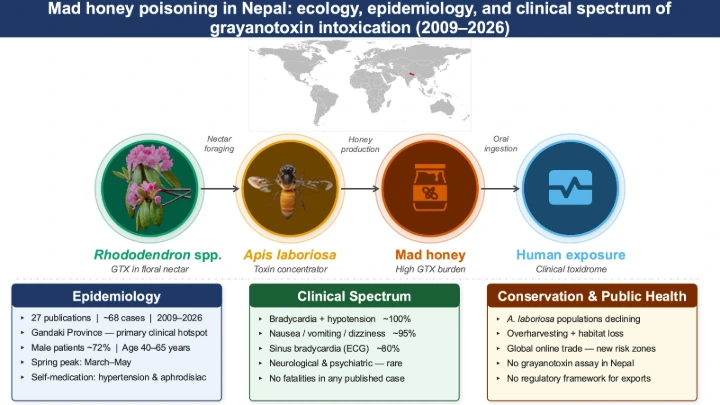
From Himalayan Tradition to Global Market
Honey has long been an important natural product in Himalayan communities, with traditional practices connected to local ecosystems, biodiversity and indigenous knowledge.
The growing international interest in distinctive Himalayan honey products, however, also raises important questions about how traditional products are represented, marketed and consumed beyond their original cultural and ecological contexts.
The discussion around mad honey provides an opportunity to look more closely at the relationship between traditional knowledge, biodiversity, agriculture, food systems, consumer awareness and responsible commercialization.
Bringing a Himalayan Perspective to a Global Conversation
Dr. Prayan Pokharel's contribution helps bring perspectives from Nepal and the Himalayan region into an increasingly global conversation.
For CESAR, such knowledge exchange is particularly important. Research and evidence generated from the Himalayan context can contribute to broader discussions on sustainable agriculture, biodiversity conservation, natural products and the responsible use of local ecological resources.
It also demonstrates the importance of connecting local knowledge with scientific research and public communication.
Why This Matters for Nepal
Nepal's diverse ecosystems support a wide range of agricultural and natural products that are closely connected to local communities and traditional practices. As these products receive increasing attention in national and international markets, there is a need for informed discussion around their ecological, cultural, economic and safety dimensions.
Greater public awareness can help ensure that traditional products are understood within their appropriate context and that consumers make informed decisions based on reliable information.
At the same time, traditional knowledge holders and local communities should be recognized as important contributors to discussions about the sustainable management and responsible use of natural resources.
CESAR's Commitment to Knowledge Sharing
At CESAR, we believe that research becomes more meaningful when scientific knowledge is communicated beyond academic and institutional boundaries.
Our work brings together environmental research, sustainable agriculture, biodiversity conservation, climate resilience, technology and community engagement to address emerging challenges in Nepal and the wider Himalayan region.
The contribution of CESAR researchers to international platforms such as The Conversation provides an opportunity to share perspectives from Nepal with a wider audience and encourage evidence-based conversations about issues affecting our environment, agriculture and communities.
A Note on Consumer Awareness
Products associated with traditional practices can have different characteristics depending on their biological, ecological and geographical context. Information circulating online may not always provide sufficient context about potential risks.
Readers are therefore encouraged to rely on credible scientific and public-health information when making decisions concerning unfamiliar natural products.
This CESAR feature is intended to promote public awareness and informed discussion and is not a substitute for professional medical or food-safety advice.
Read the Full Article
We encourage readers interested in the subject and Dr. Pokharel's contribution to read the original article published by The Conversation:
“Mad honey that can stop your heart is now being sold online worldwide.”
Read the full article on The Conversation